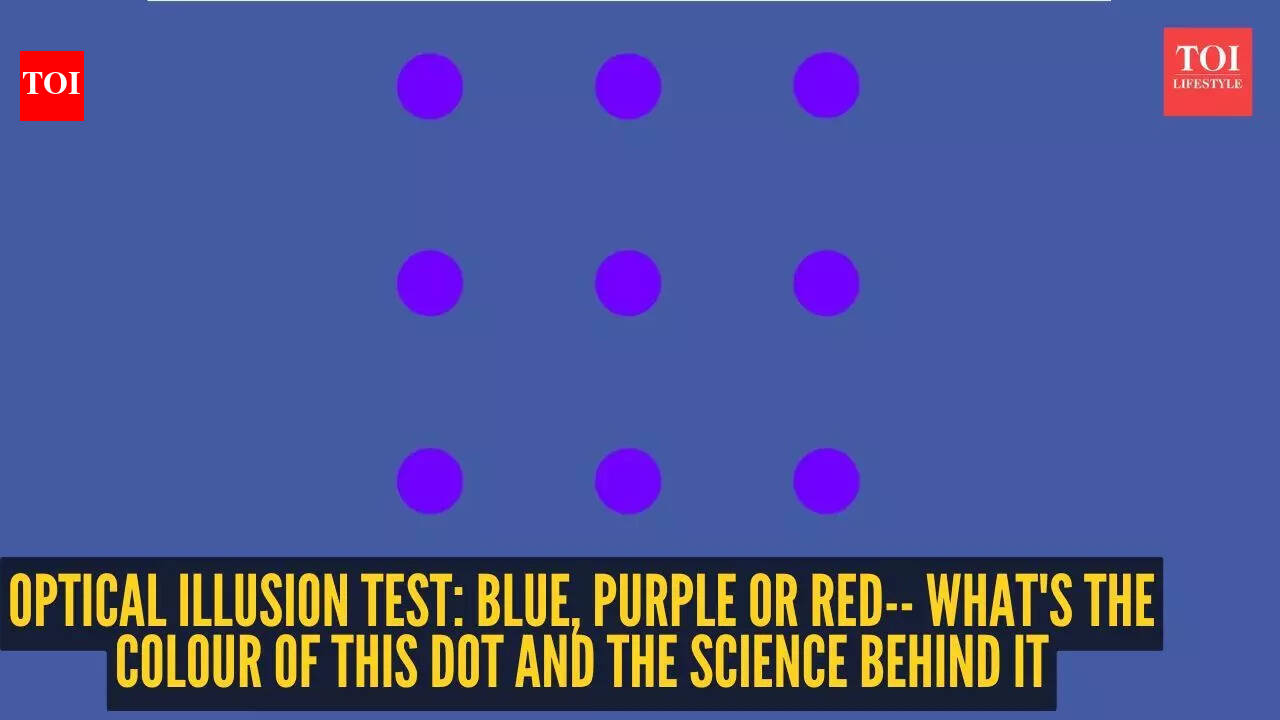
Sometime back, Hinnerk Schulz‑Hildebrandt, a biomedical optics engineer at Harvard Medical School, stumbled on something odd while checking a flight map on his phone. As his eye followed the flight path, a line that looked purple straight ahead appeared to shift to blue when he caught it in his peripheral vision. The color seemed to flicker between purple and blue depending on where he was looking: purple when he stared right at it, and bluer when he saw it from the corner of his eye. Instead of brushing it off, he leaned into the weirdness and turned it into a visual illusion that shows just how flexible and surprising color perception can be.
The illusion, recently published in the journal Perception, features nine small purple dots resting on a soft blue background. When people with normal color vision fix their gaze on one of the dots, something strange happens: the dot in the center of their vision appears more clearly purple, while the surrounding dots start to look a little bluer. At first glance it feels like a simple trick of the eye, but it actually reveals some fascinating quirks in how our eyes and brains handle color.
Part of the reason this illusion works lies in the way our retinas detect color.
Special cells called cones are responsible for picking up different wavelengths of light, and there are different types for red, green, and blue. In the very center of our retina—called the fovea centralis, the part we use when staring directly at something—there are relatively few blue‑sensitive cones. That means our central vision is less tuned to blue than the areas around it. When we look straight at a dot, our brain is getting less “blue” input from the center of our visual field, so the color appears to shift toward purple, even though the actual hue on the screen hasn’t changed.
There’s another quirk that makes this effect even stronger. Right in front of the fovea sits a thin layer of yellow pigment that acts like built‑in sunglasses, absorbing some blue and near‑ultraviolet light before it even reaches the retina. This yellow filter quietly blocks a bit of blue in the very center of our vision, which is why the dot under our direct gaze looks less blue and more purple. In the periphery, where this yellow layer is thinner or absent, more blue light gets through, so the same color appears more blue when we’re not looking at it head‑on. As visual neuroscientist Jenny Bosten from the University of Sussex explains, our brains are so used to this subtle imbalance that they usually “calibrate” it out, so we don’t notice the difference—until an illusion like this one pulls it into the spotlight.
The color of the background in Schulz‑Hildebrandt’s illusion also plays a key role. Our brain doesn’t see color in isolation; it always compares it to what’s around it, a process called simultaneous contrast. For example, when a gray circle sits on a reddish background, it looks slightly greenish because our brain interprets it as “less red.” In the same way, a dot that’s a mix of blue and purple looks more purple when it’s surrounded by a blue background, because our brain is suppressing the similar blue tones. Combine this effect with the fact that our central vision already under‑sees blue, and the result is a striking visual shift: one dot seems richer in purple, while the others fade toward blue, even though every dot is the same.
Interestingly, this illusion also ties into an older, related phenomenon called Maxwell’s spot, in which people perceive a faint red or yellowish dot near the center of their vision under certain lighting conditions. Last year, experimental psychologist Akiyoshi Kitaoka of Ritsumeikan University in Japan independently created his own version of the Maxwell’s spot illusion using blue, green, or red dots on solid blue or green backgrounds to highlight how weak blue perception is in the center of our vision. Bosten notes that Schulz‑Hildebrandt’s blue‑on‑blue background likely makes the effect even more noticeable by stacking multiple known tricks of the eye: the yellow pigment layer, the uneven distribution of blue cones, and the way neighboring colors influence each other.
In the end, the illusion doesn’t reveal a completely new process in how our eyes work, Bosten says, but it does weave together several well‑understood mechanisms to create something that feels freshly surprising. It’s a gentle reminder that what we see isn’t a direct window into reality, but a carefully edited translation shaped by the structure of our eyes and the habits of our brain.